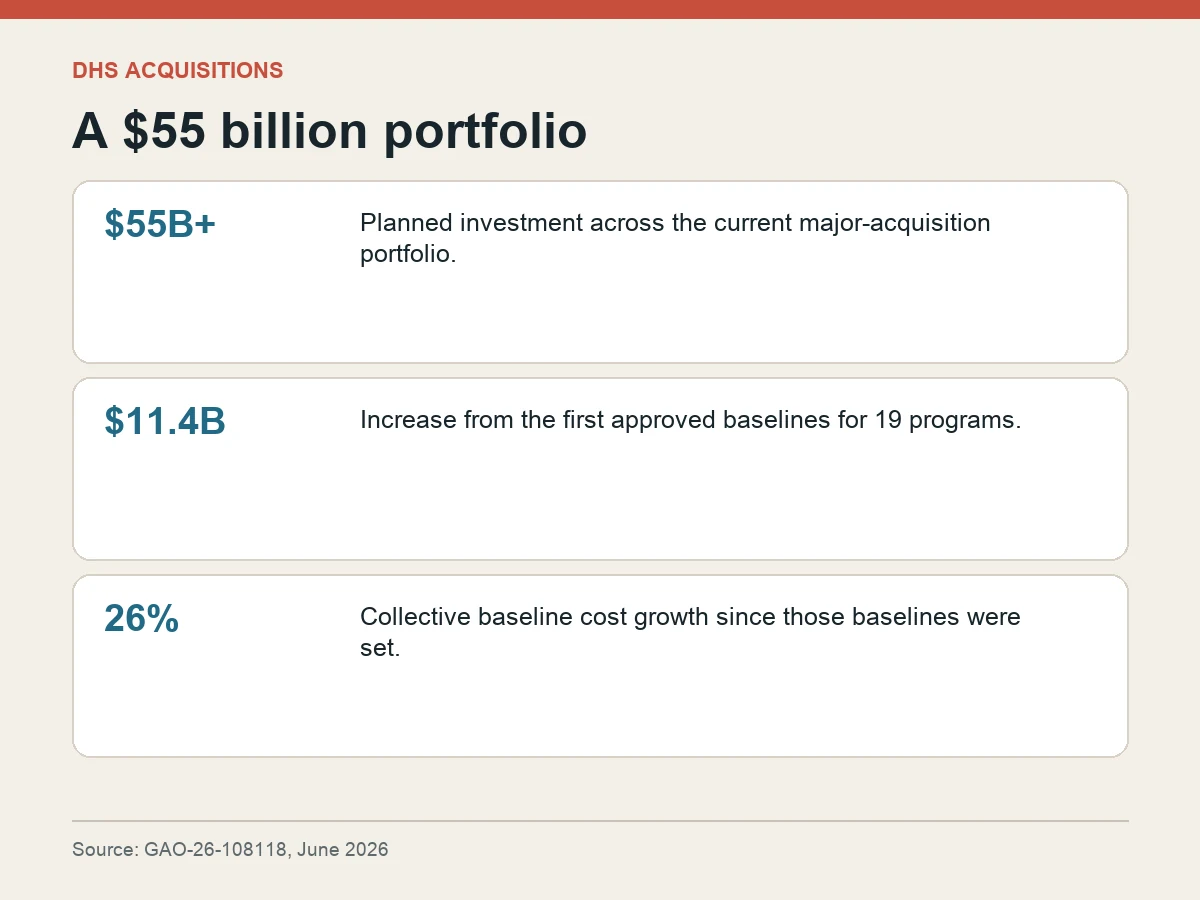
The Department of Homeland Security plans more than $55 billion in major acquisitions, but the approved cost baselines for 19 programs have collectively risen $11.4 billion from their original plans, according to the Government Accountability Office’s annual review.
GAO selected 27 of the department’s largest programs, generally those expected to cost more than $300 million. Nineteen had reached the point where DHS had approved baseline goals for cost, schedule and performance; the other eight were not yet required to have that approval.
Fifteen of the 19 baselined programs had revised their goals at least once by Sept. 30, 2025. The collective increase was 26 percent, and most revised programs delayed their plans for delivering full capability. A revised baseline resets the comparison point, so current compliance does not erase growth from the first plan.
Eighteen programs were meeting their most recent baselines. The exception was the Coast Guard’s Offshore Patrol Cutter, which was working toward another revision to reflect schedule delays and cost increases. GAO’s finding therefore combines broad compliance with revised plans and substantial accumulated growth.
Staffing added a second risk. Eight programs lost at least 20 percent of their staff during fiscal 2025, reductions GAO said removed subject-matter expertise and technical skills that programs need to reach future milestones.
Department-level oversight also changed. DHS dissolved the office responsible for major-acquisition oversight in October 2025 and moved some responsibilities elsewhere. Officials were still uncertain in January about the level of central review that would continue; at least one part of the office was reconstituted in May.
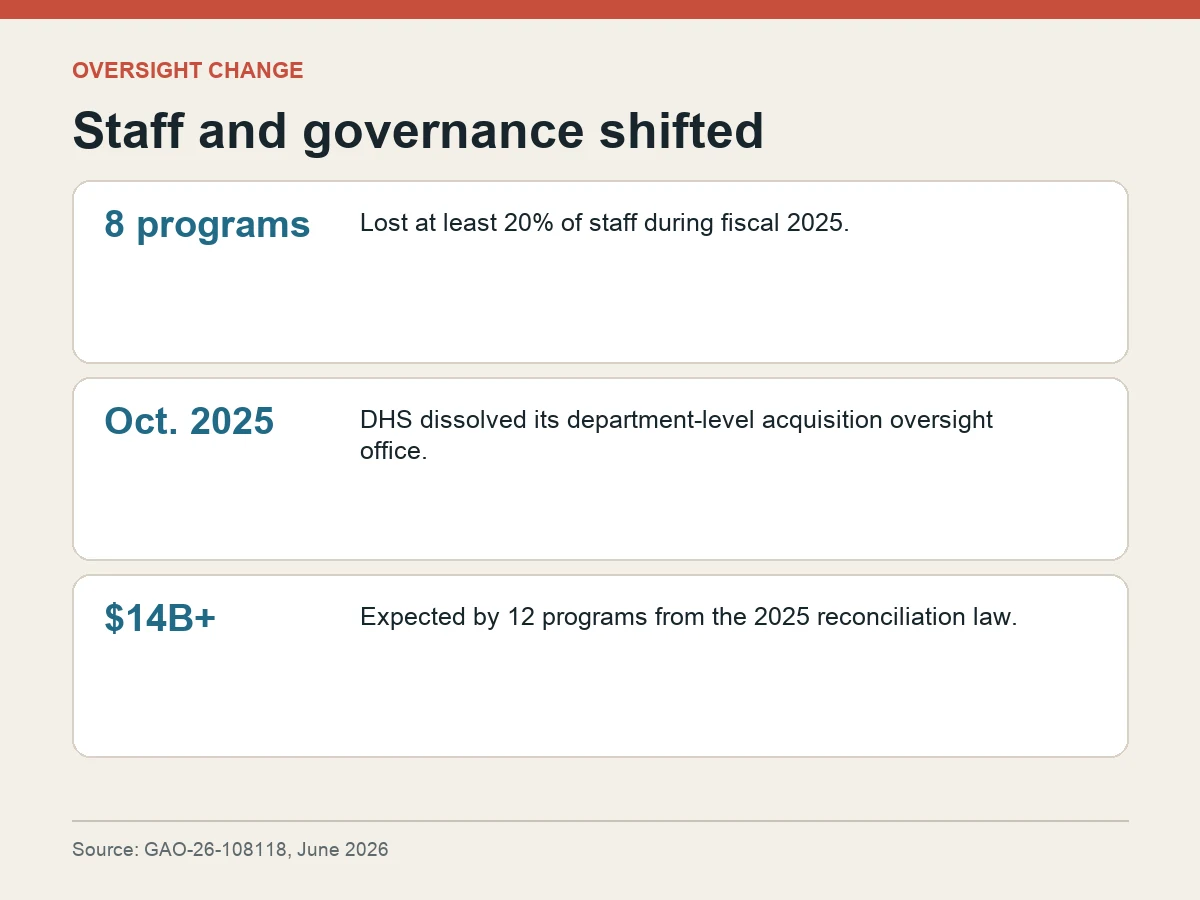
New money is arriving during that transition. Twelve of the 27 programs expected at least $14 billion from the 2025 Budget Reconciliation Act, with most directed toward Coast Guard and Customs and Border Protection work.
The figures describe different layers of the portfolio. More than $55 billion is planned investment, $11.4 billion is growth against first baselines for the 19 analyzed programs, and $14 billion is expected supplemental funding for 12 programs. They should not be added as if they were one budget total.
GAO made no claim that every program is failing. Its warning is structural: revised baselines, staffing losses, a changing oversight chain and a large funding increase are converging, making consistent cost and schedule control harder precisely when the portfolio is expanding.