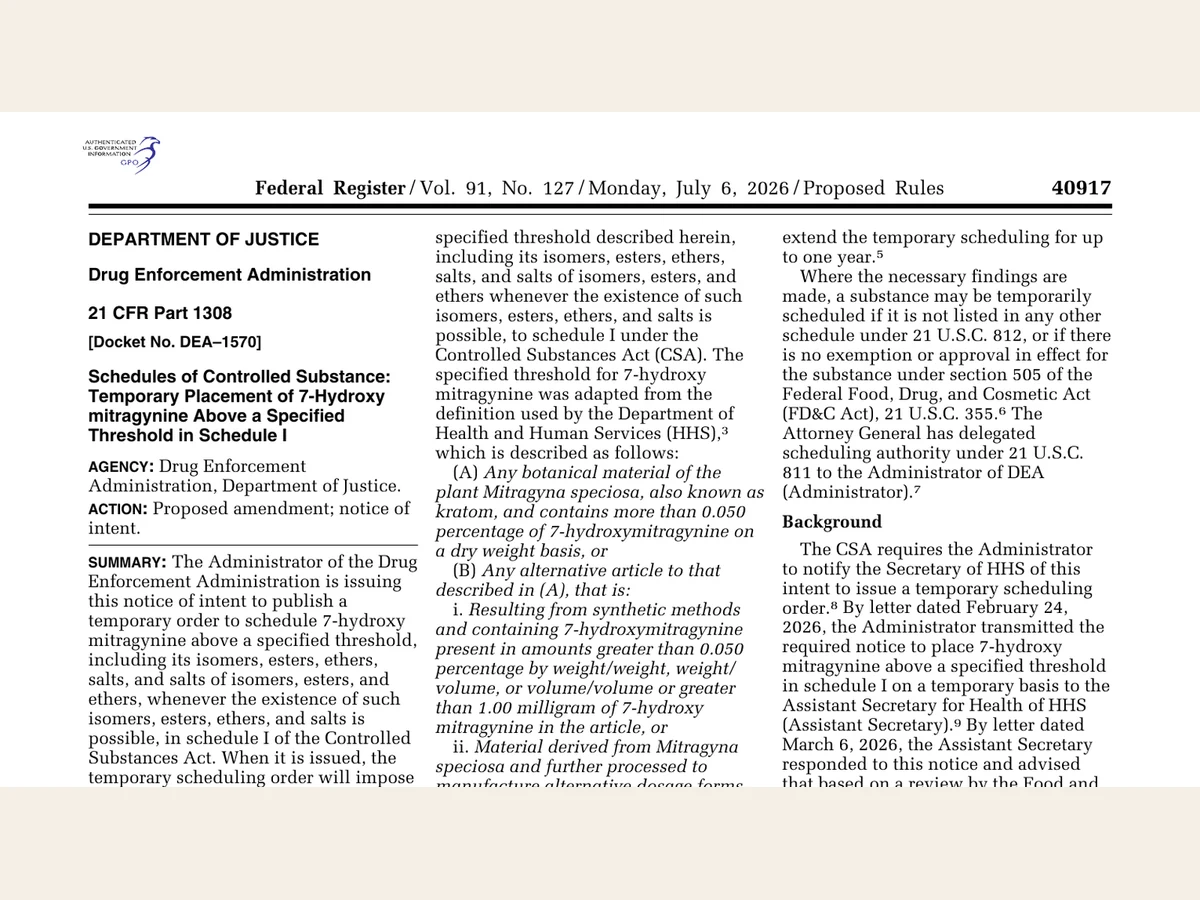
A federal emergency scheduling action could place concentrated 7-hydroxymitragynine, usually called 7-OH, into Schedule I within days. The action is not yet in force. The Drug Enforcement Administration published a notice of intent on July 6 and said a temporary order may be published on or after Aug. 5, 2026. If issued, the order would take effect upon publication.
The proposed action is narrower than a blanket ban on kratom. It targets material above a numerical 7-OH threshold and is accompanied by a separate notice covering mitragynine pseudoindoxyl, MGM-15 and MGM-16. Federal officials say ordinary kratom leaf without enhanced 7-OH is not the intended target. That distinction is important, but the threshold, testing method and meaning of a one-milligram-per-article limit still require clarification.
The scientific record supports serious concern about concentrated 7-OH products. The same record also contains large gaps in human dosing, causation and population-level risk. HHS gave the public a narrow opportunity to submit evidence about the threshold and how it should be measured, but the form closed after July 31.
The HHS comment form closed after July 31
The Department of Health and Human Services accepted comments through 11:59 p.m. Eastern time on Friday, July 31. The form closed after July 31. Comments could support the proposed threshold, oppose it or propose a different threshold or measurement system.
The docket was not a general referendum on whether 7-OH should be scheduled. HHS said it was seeking data on what concentration or quantity creates an imminent hazard to public safety and whether the threshold should be expressed differently. Comments focused only on the general safety or usefulness of kratom could fall outside the questions HHS agreed to consider.
What comments could address
- Evidence supporting or disputing the proposed 0.050% threshold.
- Evidence supporting or disputing the separate one-milligram-per-article limit.
- Whether the measurement should be per tablet, serving, package, container, weight, volume or another unit.
- How laboratory variation, storage, oxidation or product type could affect classification.
- A scientifically supported alternative threshold, transition period or testing standard.
- Relevant personal, clinical, laboratory or commercial experience, with financial interests disclosed.
HHS advises commenters on open rules to identify the specific issue, explain their position, offer alternatives where possible and support the submission with evidence. A personalized comment tied to the actual questions is more useful than a copied slogan, regardless of whether the commenter supports or opposes the action.
What DEA says would be covered
| Material | Proposed Schedule I trigger |
|---|---|
| Botanical kratom material | More than 0.050% 7-OH by dry weight |
| Synthetic or further-processed material | More than 0.050% by weight or volume, or more than 1.00 milligram of 7-OH in the article |
| Mitragynine pseudoindoxyl, MGM-15 and MGM-16 | Covered by a separate DEA notice without the 7-OH threshold |
The 7-OH notice says the order would cover the compound, its salts, isomers and salts of isomers whenever the specified chemical relationship exists. It would apply to products exceeding either applicable threshold. DEA says the temporary order would impose Schedule I controls and the related administrative, civil and criminal sanctions on manufacture, distribution, importation, exportation, research, analysis and possession.
The temporary placement would last two years and could be extended for one additional year while permanent scheduling proceedings are underway. The earliest possible publication date is Aug. 5, but the notice does not guarantee that the order will appear that day.
Why the move felt sudden
The scheduling push did not literally emerge without warning. HHS and FDA publicly announced in July 2025 that FDA was recommending federal control of concentrated 7-OH products. FDA issued warning letters and released a scientific assessment.
The decisive 2026 interagency exchange was not public at the time it occurred. DEA notified HHS on Feb. 24 that it intended to use the emergency scheduling authority. HHS responded on March 6 that it had found no approved drug applications or active investigational applications for the substances and had no objection. The public Federal Register notices did not appear until July 6.
DEA is proceeding under the temporary scheduling provision of the Controlled Substances Act. In its notice, the agency says the ordinary Administrative Procedure Act notice-and-comment requirements do not apply and that a temporary scheduling order is not subject to judicial review. The HHS request for information therefore functions as a narrow evidence docket, not the broader rulemaking process many readers may assume is occurring.
What the science establishes
7-OH is an opioid-active kratom alkaloid and a metabolite of mitragynine. It acts at the mu-opioid receptor. Commercial producers can also create enriched 7-OH material by oxidizing mitragynine, producing concentrations far above the trace amounts typically reported in traditional leaf.
Animal and laboratory studies cited by FDA and DEA show opioid-like reinforcement, physical dependence, withdrawal and respiratory depression. Naloxone can reverse respiratory effects in animal models. The commercial market also presents an obvious dosing problem: DEA says products it reviewed were labeled with amounts ranging from about one milligram to hundreds of milligrams per serving.
DEA cites adverse-event reports and toxicology cases that include serious outcomes and deaths. Those are legitimate warning signals, not clean causal estimates. FDA's scientific assessment says direct 7-OH consumption can be difficult to distinguish from 7-OH formed after mitragynine use, many toxicology cases involve additional drugs, and the available surveillance systems historically did not consistently separate concentrated 7-OH products from broader kratom exposure.
What the science does not establish
No controlled clinical trials have established a safe isolated 7-OH dose, a standardized therapeutic dose or a reliable population-wide rate of addiction, overdose or death. The available evidence does not show how many deaths were caused principally by 7-OH rather than by multiple substances or other medical factors.
The public record also does not demonstrate why 0.050% and one milligram are the uniquely correct dividing lines. FDA reports trace concentrations in traditional Malaysian leaf around 0.005% to 0.015% and older commercial samples around 0.01% to 0.04%. It also reports a consumer-provided sample set ranging from below 0.005% to 0.21%, with a mean of 0.01%. The published summary does not provide enough sample-level context to determine which higher readings came from unprocessed leaf, extracts or altered products.
The one-milligram limit creates another practical question. The notice uses the word article, but it does not explain in ordinary consumer terms whether that means a tablet, gummy, bottle, beverage, package or another unit. HHS's request for alternative measurement proposals is an acknowledgment that enforceable classification depends on how the product unit is defined and tested.
Nor does the existing record answer what happens after prohibition. A temporary order may reduce access to aggressively marketed high-dose products. It may also push dependent consumers toward illicit products, counterfeit pills, uncontrolled synthesis or abrupt withdrawal. Those downstream effects are policy questions that deserve evidence even though the HHS docket was drafted more narrowly.
RFK Jr. and Trump are involved, but not in identical ways
HHS Secretary Robert F. Kennedy Jr. is directly tied to the action. He announced FDA's scheduling recommendation in 2025, and HHS says the department reviewed the science and recommended the current DEA action. The department describes the move as Trump administration policy and emphasizes that it is aimed at concentrated or enhanced 7-OH rather than natural kratom leaf.
President Donald Trump has also discussed the subject publicly. An official White House video from a May 11 maternal-health event shows him referring to natural 7-OH and saying the administration was looking at approval. The phrase was ambiguous because natural leaf contains trace 7-OH while the present enforcement action targets concentrated material. The public record establishes that the issue reached the president's attention; it does not establish that he personally selected the threshold or ordered the emergency scheduling notice.
The kratom market is divided
The federal action is not a simple dispute between government and kratom consumers. The American Kratom Association, which represents interests in the traditional kratom market, supports scheduling chemically manipulated concentrated 7-OH while arguing that ordinary leaf should remain outside the action. Groups aligned with the concentrated 7-OH market oppose the move, as do some drug-policy and harm-reduction organizations.
Those positions deserve attribution and scrutiny. Supporters point to opioid pharmacology, escalating doses, misleading retail marketing and the absence of an approved medical use. Opponents argue that emergency prohibition is disproportionate, that the threshold is underexplained, that research and pain-management options could be harmed, and that criminalization may drive consumers toward more dangerous markets. Trade groups and product manufacturers also have commercial interests in where the government draws the line.
A similar DEA action was withdrawn in 2016
DEA attempted a broader emergency Schedule I action against mitragynine and 7-OH in 2016. After receiving extensive public opposition and scientific submissions, the agency withdrew the notice and opened a regular comment process so it could consider public comments and an FDA evaluation.
That precedent shows that federal agencies can change course before an emergency order is issued. It does not mean the present notice will be withdrawn. The 2026 action is narrower, major traditional-kratom organizations support it, and the government now cites a larger preclinical and surveillance record concerning concentrated products.
How to support, oppose or seek changes
Boho News is not urging readers to take a particular position. The routes below are the official channels most likely to create a usable public record or reach an official with authority over federal policy.
1. Review the closed formal HHS comment docket
The HHS-OASH-2026-0232 form closed after July 31. Before it closed, supporters could submit evidence explaining why the proposed concentration or one-milligram limit reflected an imminent hazard; opponents could dispute the threshold; and commenters seeking modification could propose a different threshold, measurement unit, testing method, transition period or definition of article.
2. Contact Congress for broader policy requests
Members of Congress are not the decision-makers on an individual HHS docket comment, but they can request information, conduct oversight, contact the agencies and pursue legislation. A supporter can ask a member to back prompt scheduling while protecting traditional leaf below the threshold. An opponent can ask for withdrawal of the emergency notice and regular rulemaking. A person seeking changes can ask for a longer comment period, public threshold methodology, validated laboratory standards, a transition period and a plan for dependent consumers.
3. Contact the administration
The White House contact form is the direct general channel for a message to the administration. Written correspondence to the HHS Secretary can request support, withdrawal, modification, an extension or disclosure of the threshold methodology. These contacts can express a broader policy position, but the formal HHS comment form closed after July 31.
4. Report health events through health channels
People reporting a suspected adverse event should use FDA MedWatch rather than treating a policy comment as a medical report. Poison Help is available at 1-800-222-1222. An unresponsive person, severe breathing problem or other immediate emergency requires 911. Those channels document health events; they are not advocacy tools.
What happens next
The HHS comment form closed after July 31. DEA may publish the temporary Schedule I order on or after Aug. 5. If the order appears, it becomes effective upon publication and begins the temporary control period. The government may then pursue permanent scheduling through a separate process.
The next documents matter more than the rhetoric. The final temporary order should reveal whether DEA changed the threshold, clarified measurement, addressed the HHS submissions or added transition guidance. Congress and the public should also demand the analytical basis for the cutoff, the validated test method agencies expect laboratories to use and a credible plan for people who may already be physically dependent.
Until an order is published, it is inaccurate to report that the federal ban is already in effect. It is equally inaccurate to describe the action as a ban on every kratom product. The precise story is that the federal government is using an emergency mechanism to place concentrated 7-OH above a proposed threshold, plus three related substances, into Schedule I after a short and unusually narrow HHS comment period that closed after July 31.