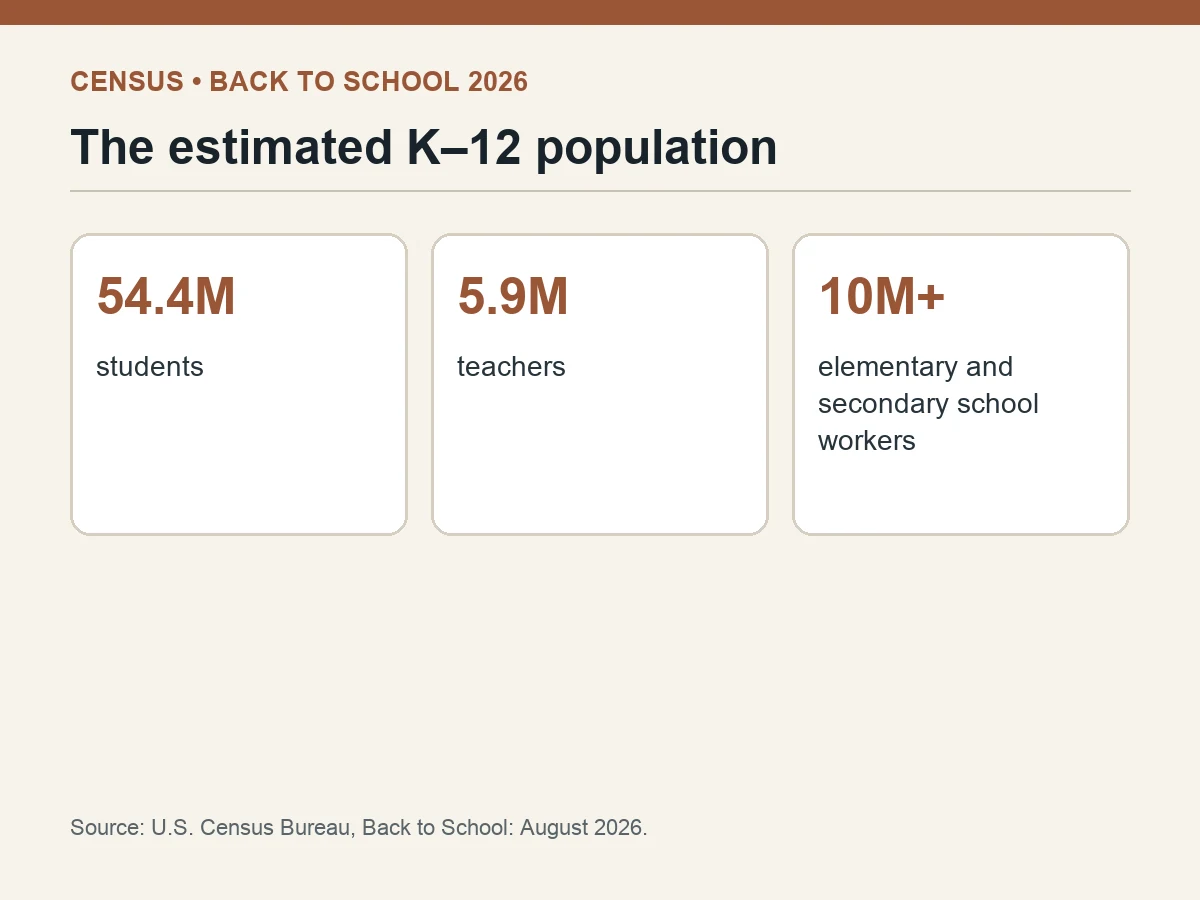
About 54.4 million students are expected in U.S. kindergarten-through-12th-grade schools this fall, supported by 5.9 million teachers and a total elementary and secondary workforce above 10 million, according to the Census Bureau’s 2026 back-to-school snapshot.
The numbers describe the national scale of the annual return, not a single opening-day head count. Census assembles the feature from its education, population and labor datasets, whose collection periods and definitions differ.
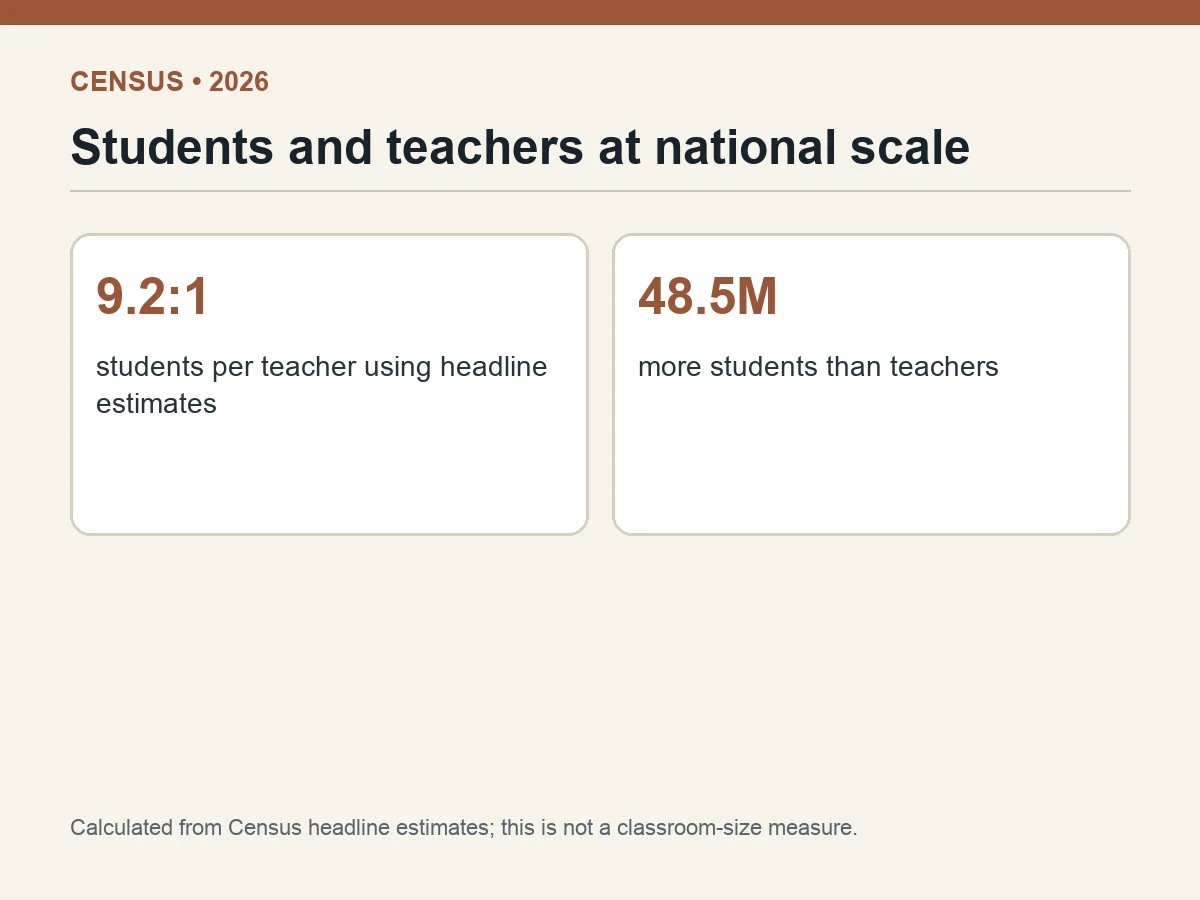
Students outnumber teachers by roughly 9.2 to one when the two headline estimates are divided. That calculation is useful for scale, but it should not be mistaken for average class size.
A teacher can work with several groups, specialists may serve multiple classrooms, and the teacher estimate includes roles that are not captured by one homeroom roster. District staffing patterns also vary widely by grade, program and geography.
The broader workforce figure—more than 10 million—shows how much of schooling happens outside the teacher count. Schools depend on administrators, aides, counselors, transportation workers, food-service staff, maintenance crews and other employees.
The 54.4 million student estimate is larger than the population of every U.S. state. It also makes small percentage changes consequential: a one-percentage-point shift would represent more than half a million students.
For local systems, the national totals are a planning backdrop rather than an operating target. Enrollment growth, special-education needs, building capacity and teacher vacancies are decided in district-level numbers.
Census releases the back-to-school collection as a statistical guide, bringing together measures that families and officials can use to understand the institution behind a familiar seasonal moment.
The collection also gives reporters and communities a common baseline for testing local claims. A district may be growing while the national total is flat, or hiring rapidly while the national workforce changes little.
The clearest takeaway is the size of the enterprise: tens of millions of students, nearly six million teachers and millions more workers returning to classrooms, cafeterias, buses and school offices across the country.