
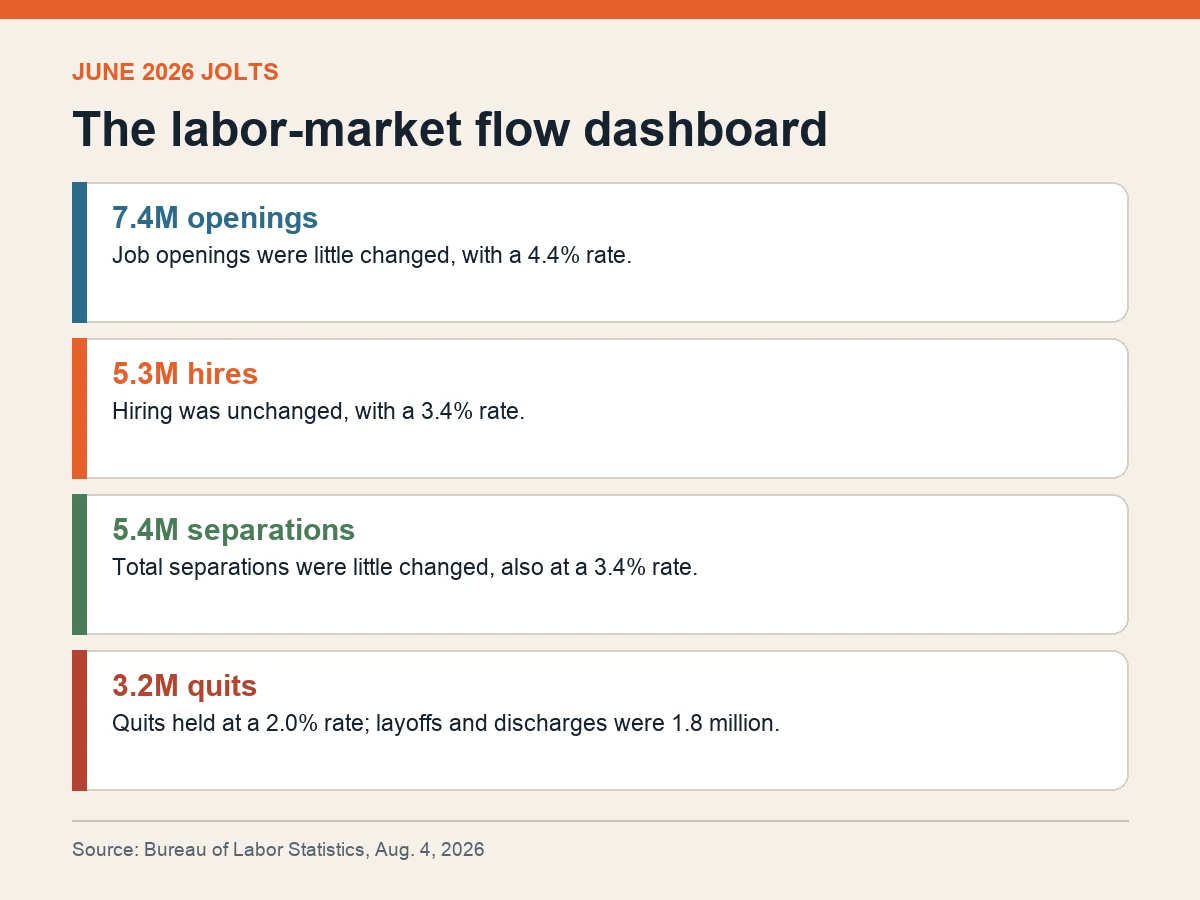
U.S. employers reported 7.4 million job openings at the end of June, while hiring held at 5.3 million, leaving the main measures of labor turnover little changed from May.
The seasonally adjusted openings rate was 4.4%, according to the Bureau of Labor Statistics’ Job Openings and Labor Turnover Survey. The hires rate was 3.4%, matching the 5.3 million people hired during the month.
Separations were similarly steady at 5.4 million, or 3.4% of employment. Within that total, 3.2 million workers quit and 1.8 million were laid off or discharged. Quits are generally voluntary; layoffs and discharges are employer initiated, so the two measures should not be combined into a single story about worker confidence.
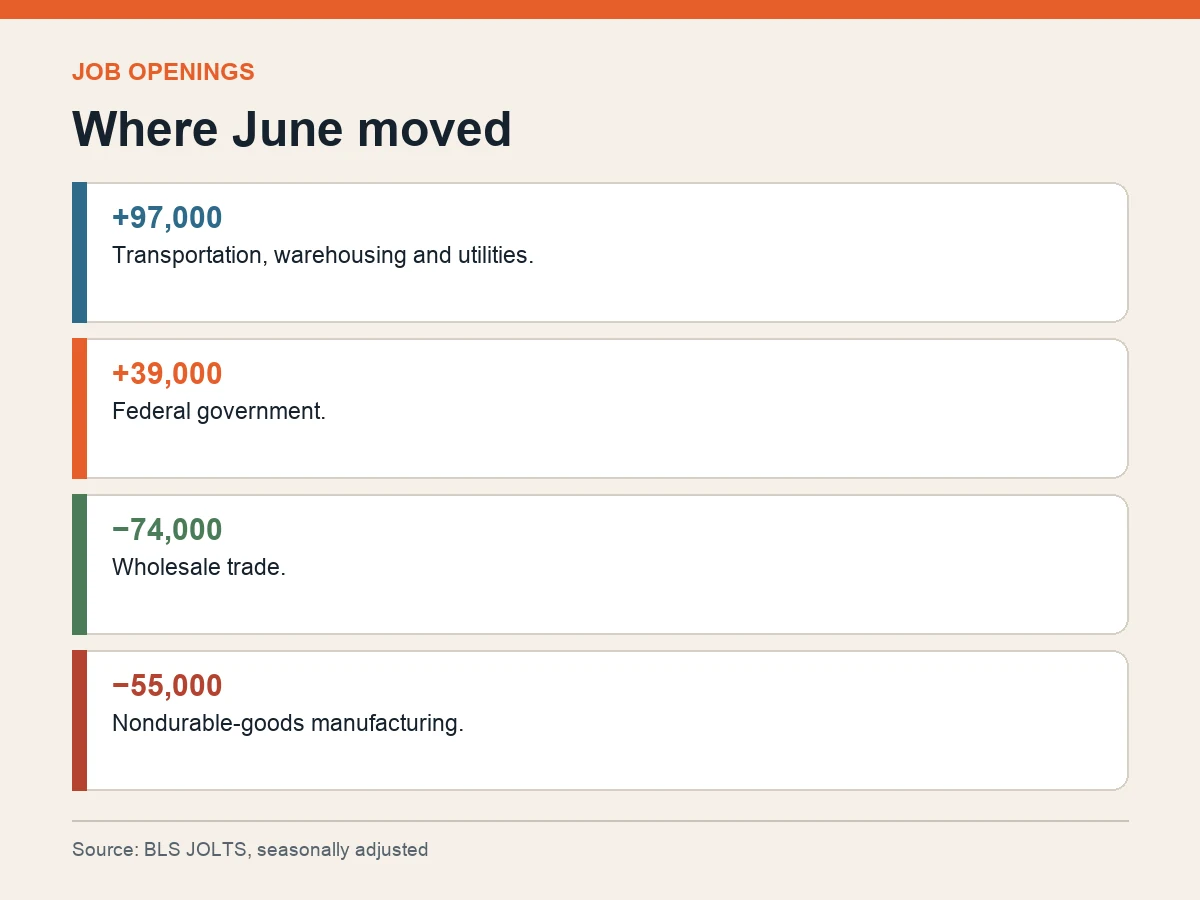
Industry detail moved more than the national total. Openings increased by 97,000 in transportation, warehousing and utilities and by 39,000 in the federal government. They fell by 74,000 in wholesale trade and by 55,000 in nondurable-goods manufacturing.
Mining and logging openings also declined by 9,000. Those sector estimates show where the monthly change was concentrated, but they do not establish why employers added or removed postings.
The prior month was revised. BLS lowered May job openings by 57,000 to 7.5 million, a reminder that the first published estimate is not final. June’s 7.4 million figure is also subject to later revision.
JOLTS measures stocks and flows rather than the same thing six ways. Openings are positions employers are actively recruiting to fill; hires count people added to payrolls; separations record workers leaving. A market can have millions of openings and still post flat hiring if matching, timing or employer demand changes.
The survey is sample based, and BLS evaluates whether monthly movements exceed the statistical uncertainty around each estimate. “Little changed” means the agency did not identify a statistically meaningful nationwide movement, not that the displayed number was identical.
June therefore reads as a holding pattern at the national level with sharper reallocations underneath: openings remained numerous, hiring did not accelerate, and selected logistics and government categories moved in the opposite direction from wholesale and factory categories.