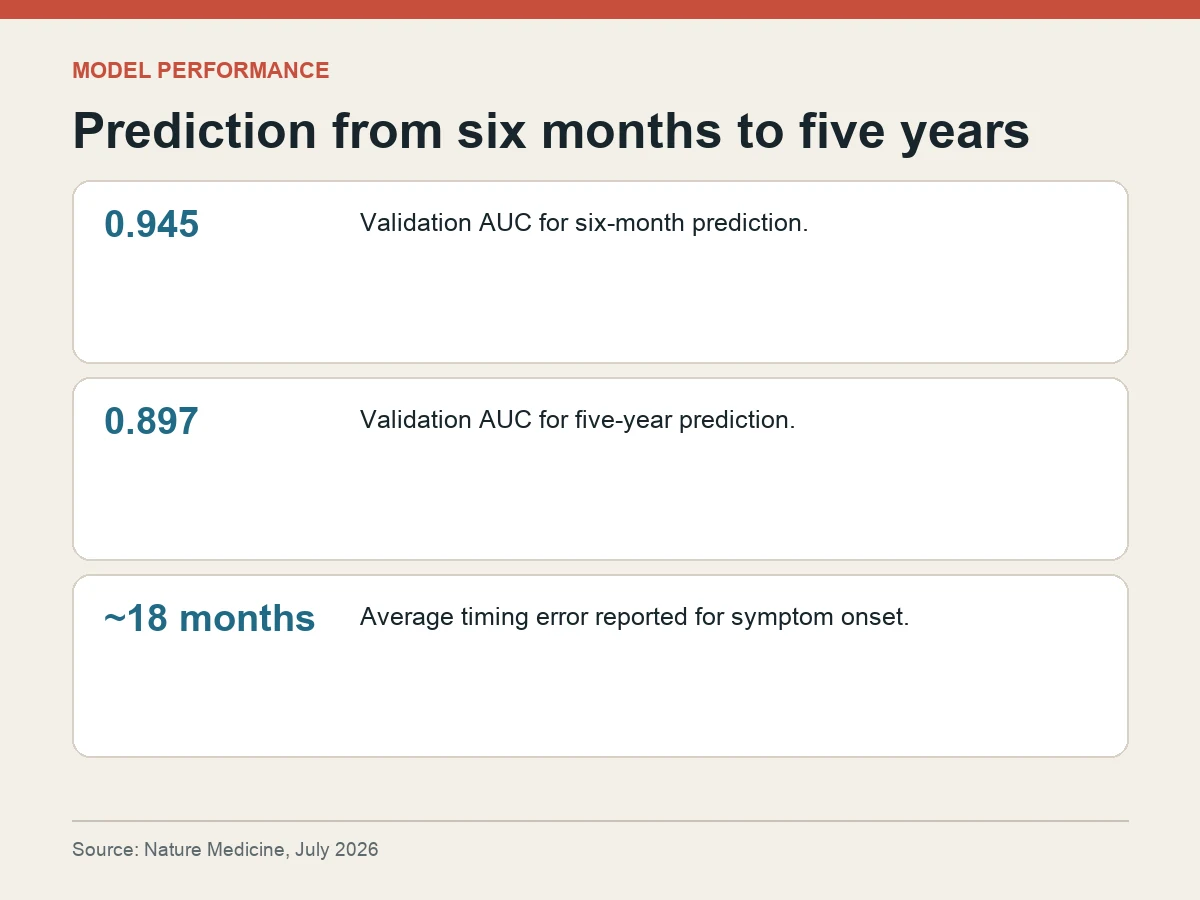
A panel of 19 blood proteins estimated when amyotrophic lateral sclerosis would become clinically apparent with an average error of about 18 months in a longitudinal study of people at elevated genetic risk, researchers reported in Nature Medicine.
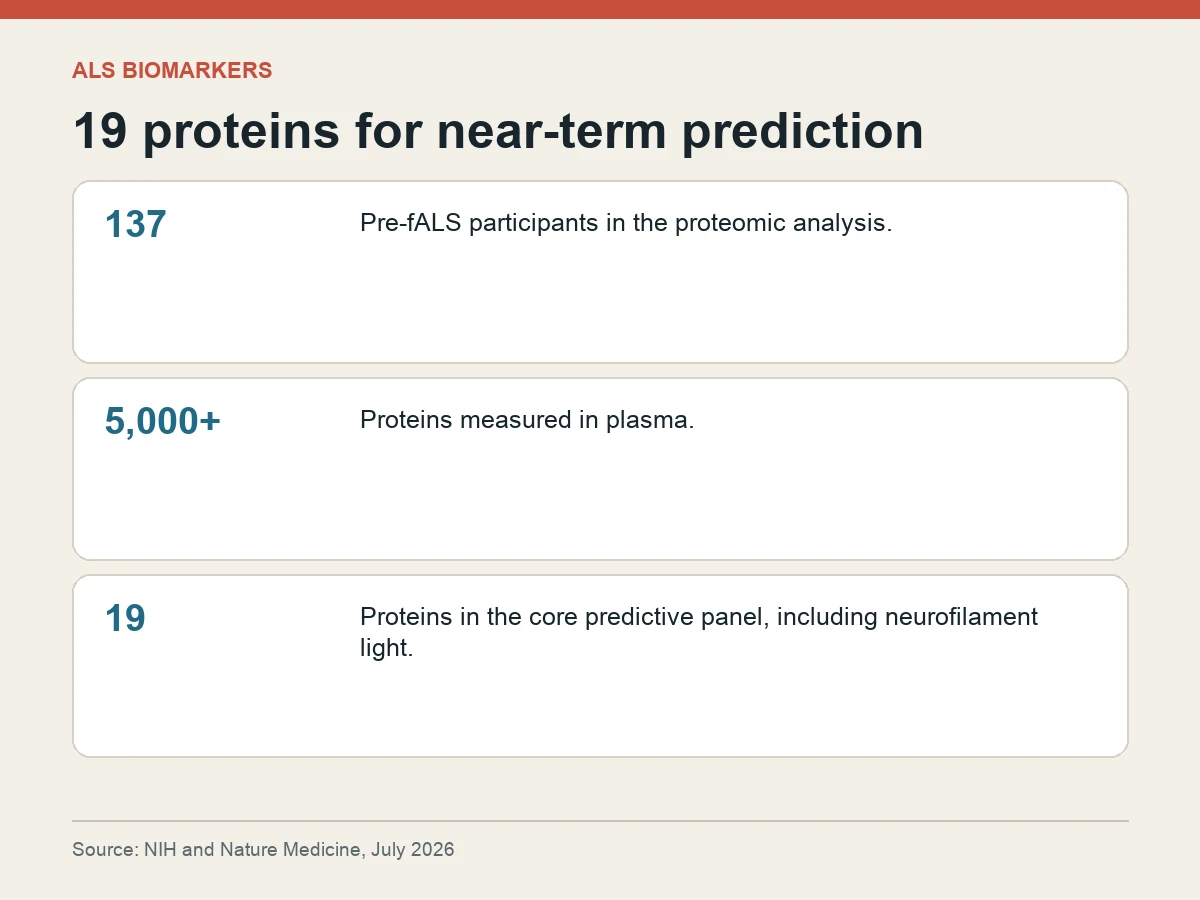
The team analyzed plasma samples from 137 participants in the NIH-funded Pre-symptomatic Familial ALS study. Thirty-three developed clinical signs of ALS or frontotemporal dementia during follow-up, giving investigators observed transitions from presymptomatic risk to manifest disease.
Using a high-throughput proteomic assay, researchers measured more than 5,000 proteins and identified 92 whose levels differed before symptoms among people who later converted. They then combined data-driven selection with expert review to build a core 19-protein panel that includes neurofilament light chain.
Models were evaluated across horizons from six months to five years. In fivefold cross-validation, the reported logistic-regression models reached an area under the receiver-operating-characteristic curve of 0.945 for six-month prediction and 0.897 for five-year prediction. AUC measures discrimination in the study data, not guaranteed accuracy for an individual patient.
The timing model’s average error of roughly 18 months is potentially useful for preventive-trial design, where investigators need to enroll carriers who are near enough to symptom onset for an intervention to be tested efficiently. It is not a precise countdown and is not approved as a clinical diagnostic.
The work expands on neurofilament light, a structural protein that rises before ALS manifestations. Multi-protein models outperformed neurofilament light alone across the reported prediction windows, suggesting that changes in muscle, neuronal and metabolic proteins together may capture more of the transition.
Researchers also examined UK Biobank data, which cover a broader population but are cross-sectional rather than the same kind of repeated presymptomatic follow-up. The authors reported similar patterns for overlapping proteins while emphasizing the limits of that comparison.
The next test is replication in larger independent longitudinal cohorts with more observed conversions. The discovery group is rare, genetically enriched and modest in size; machine-learning performance can look stronger in such datasets than it will after deployment.
The result therefore belongs in a trial-planning frame, not a promise of prevention. It offers a more informed estimate for when symptoms may emerge and a possible way to target research before irreversible motor-neuron damage accumulates, while leaving the therapeutic benefit itself to be demonstrated.